Can Neck Pain Cause Headaches?

Why does my head ALSO hurt when my neck hurts?
If you have ever felt a dull, persistent ache creeping from the base of your skull toward your temple, you have likely asked yourself: Is this just a headache, or is my neck the problem?
While migraines and tension-type headaches are common, there is a third, often overlooked culprit: the Cervicogenic Headache (CGH). Unlike primary headaches, CGH is a ‘secondary’ headache, meaning the pain you feel in your head is actually a symptom of an underlying musculoskeletal issue in the cervical spine (the neck).
In this guide, we dive into the anatomy of this connection, how we assess it using musculoskeletal protocols, and why an integrated approach is vital for long-term relief.
The Science: Why the Neck Controls the Head
To understand why a neck joint can cause pain behind your eye, we have to look at the “relay station” of the brain: the Trigeminocervical Nucleus.
The “Cross-Talk” Phenomenon
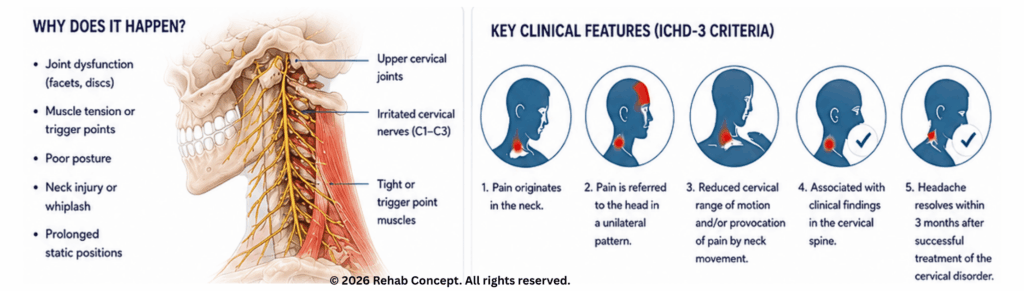
The nerves originating from the top three levels of your spine (C1, C2, and C3) share a common pathway with the Trigeminal Nerve, which is responsible for sensation in your face and head. When the joints or muscles in your upper neck are irritated (most often due to poor posture, injuries like whiplash, or stiffness due to tension in tight muscles and poorly mobile joints) they send constant pain signals to this relay station.
Because these pathways overlap, the brain often misinterprets the signal. It perceives the pain as coming from the head or face rather than the neck. This is a classic example of referred pain.
Common Symptoms of Cervicogenic Headaches
- Unilateral Pain: Pain that usually stays on one side of the head.
- Reduced Mobility: A noticeable stiffness when trying to look over your shoulder.
- Triggered by Movement: The headache worsens with certain neck positions or sustained ‘tech neck’ posture.
- Referred Pain Points: Pain that radiates from the back of the head toward the forehead or behind the eye.
Potential Risk Factors: From Posture to Oncology
Anyone can develop a cervicogenic headache, but certain factors increase the likelihood:
- Sedentary Ergonomics: Prolonged sitting at a desk creates a ‘forward head posture’, placing immense shearing force on the C1-C3 vertebrae.
- Previous Trauma: Old whiplash injuries from car accidents (car getting hit from behind, causing sudden movement of your neck due to the impact) or sports-related neck strain can lead to chronic joint dysfunction. Even injuries like falling down and hitting your arm or shoulder can generate enough force to affect the neck!
- Oncology-Related Stiffness: For patients undergoing treatment for cancer (particularly in the head, neck, or chest) scar tissue from surgery or radiation can lead to significant cervical restriction. This ‘tension’ that you feel isn’t just muscular; it can affect the entire neurological and lymphatic flow of the neck region.
How We Assess the Connection
A ‘one-size-fits-all’ massage isn’t the answer. We often see people who have done many sessions of generic massage and report temporary improvements that don’t seem to stick. That’s because true resolution requires a clinical assessment to identify what exactly is contributing to your pain:
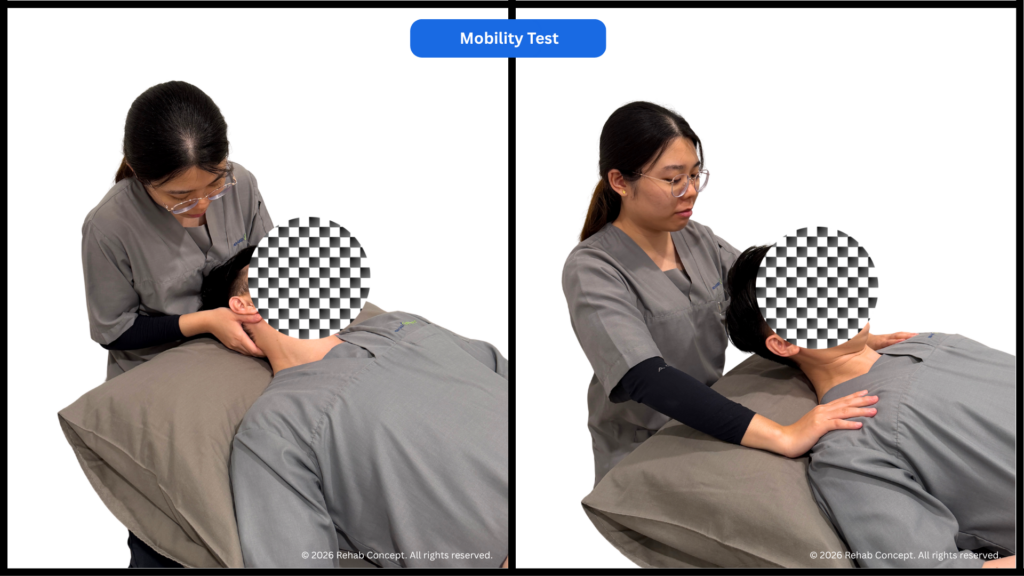
- Upper Cervical Mobility Tests: We specifically isolate the movement of the C0-C1 and C1-C2 joints to see if they reproduce your headache symptoms.
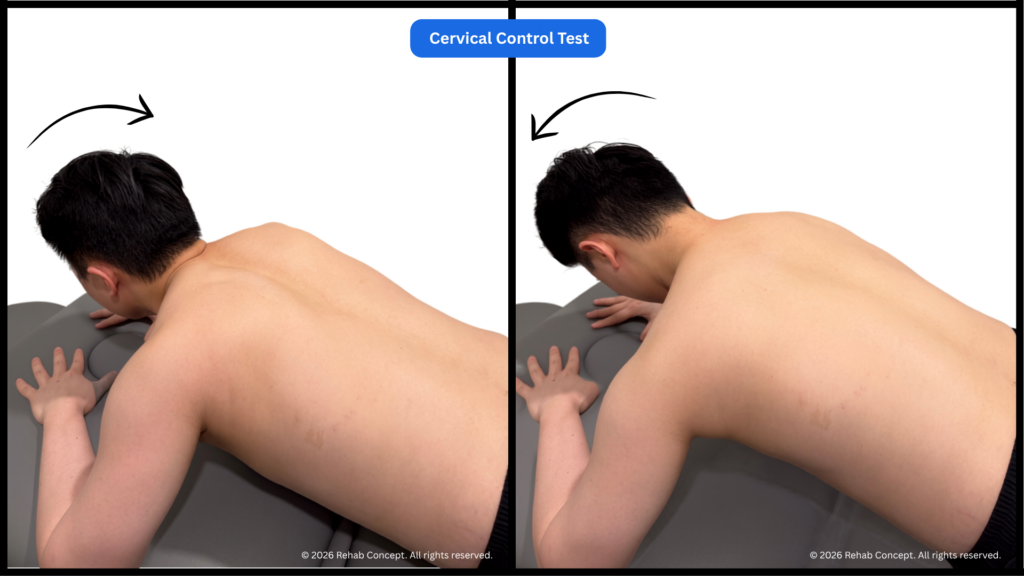
- Cranio-Cervical Flexion Test: We assess the endurance of your ‘deep neck flexors’, the internal stabilizers that should be doing the heavy lifting for your head.
- Functional Movement Screening: We look at how your neck moves in coordination with your ribcage and diaphragm.
- Musculoskeletal Chain Assessment: Assessing the joints that support your neck is also equally important. Many of the muscles that move the shoulder, chest, and trunk also connect to the neck, and affect movement and pain sensitivity. Imbalances along the entire movement chain can cause neck overload, leading to headaches in the long-term.
Advanced Treatment Options
1. Manual Therapy & Joint Mobilization
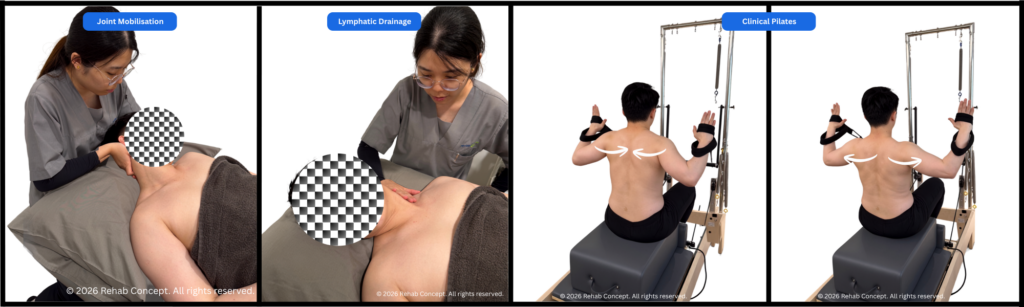
We use evidence-based manual techniques to restore ‘joint play’ in the upper cervical spine. This reduces the mechanical irritation on the nerves and calms down the pain signals being sent to the trigeminocervical nucleus. If a person has been experiencing long-term stiffness and poor posture, their joints may need some ‘help’ to get moving again!
2. Pilates Rehabilitation
At our clinic, we move beyond simple stretching. Traditional exercises often focus only on the neck. Our Rehabilitative Pilates approach looks at the whole body. Scapular Stability, by targeting your shoulder blades. If they are not stable, your neck muscles (like the upper trapezius) must work overtime to hold up your arms, indirectly affecting neck tension. Core-Neck Connection, by using Pilates to strengthen the deep stabilizers of the spine, ensuring your neck isn’t ‘hijacking’ the job of your core. And lastly, Postural Awareness, by retraining your brain to maintain a stable spine which naturally offloads the upper cervical joints (C1-C3) that trigger headaches.
3. Lymphatic Drainage in Rehab
Especially for our patients in oncology rehabilitation, lymphatic congestion can lead to a heavy, ‘pressurized’ feeling in the neck. By using gentle manual lymphatic drainage, we reduce edema and interstitial pressure, which in turn reduces the chemical and mechanical irritation on the cervical nerves.
What Does the Evidence Say?
1. Mulligan Manual Therapy (MMT) + Exercise
A landmark randomized controlled trial published in the Journal of Physiotherapy investigated the effectiveness of adding manual mobilization to a standard exercise program for patients with cervicogenic headaches (Satpute et al., 2024).
- The Treatment: Participants were divided into three groups: MMT plus exercise, sham (placebo) manual therapy plus exercise, and exercise alone.
- The Dosage: A 4-week regimen consisting of supervised clinical sessions focused on upper cervical mobilization with movement (SNAGs) combined with targeted neck strengthening.
- The Results: The MMT plus exercise group saw a superior reduction in headache frequency, decreasing by 2 days per month immediately and maintaining a 4-day reduction at the 26-week follow-up compared to exercise alone. Significant improvements were also noted in headache intensity, duration, and disability scores (Satpute et al., 2024).
2. Movement Retraining for Lasting Stability
Pilates is no longer just a fitness trend; it is a powerful rehabilitative tool for cervical stability. Research shows that Pilates focuses on the ‘kinematic chain’, ensuring the neck is supported by the mid-back and core.
- Source: Mallin, G., & Murphy, S. (2013). Journal of Bodywork and Movement Therapies.
- The Treatment: A supervised Pilates program focusing on “segmental spinal organization,” scapular stability, and deep neck flexor activation.
- The Dosage: One 60-minute session per week for 10 weeks.
- The Results: Participants reported a significant reduction in pain (VAS scores) and a marked improvement in the Neck Disability Index (NDI). The study concluded that Pilates is effective in reducing disability and pain intensity in patients with chronic neck pain by improving postural alignment and muscular endurance.
- Lymphatic Drainage for Neck Pain & Oncology Rehab
For patients with complex neck pain, particularly those in oncology recovery, traditional joint work is only half the battle. Research shows that managing tissue fluid and inflammation is vital.
- Source: Smith, B. G., et al. (2018). Otolaryngology–Head and Neck Surgery.
- The Treatment: Manual Lymphatic Drainage (MLD) as part of Complete Decongestive Therapy (CDT) for head and neck lymphedema and associated pain.
- The Dosage: Daily or frequent sessions (up to 5x/week) during the intensive phase, typically totaling 24 sessions.
- The Results: Patients saw a dramatic reduction in pain scores, moving from an average of 7.8/10 to 3.6/10. Furthermore, cervical range of motion (rotation) increased by up to 55% over 12 months of therapy. By reducing the ‘pressurized’ environment in the neck tissues due to swelling, MLD decreases the mechanical and chemical irritation on the cervical nerves.
Frequently Asked Questions (FAQ)
- Can a neck-related headache cause dizziness?
Yes. This is known as cervicogenic dizziness. The nerves in your upper neck help your brain understand where your head is in space. If those nerves are sending “noisy” signals due to stiffness, you may feel lightheaded.
- How long does it take to see results?
While every patient is different, many experience significant relief within 3 to 6 sessions as we restore joint mobility and begin corrective exercises.
- Is it different from a migraine?
Yes. Migraines are typically vascular and neurological, often involving light sensitivity and throbbing. Cervicogenic headaches are mechanical, tied directly to the movement and health of your neck joints. However, tension and weakness in the neck can also contribute to the development of migraine especially if you are prone to migraines.
- What can I do for immediate relief before a physiotherapy appointment?
You could consider these strategies to temporarily reduce your pain before visiting us: Apply ice packs around the upper cervical joints (C1-C3) to reduce pain sensitivity; it is located around the back of your head, at the base of your skull. You could apply up to 10 minutes every 1 to 2 hours as needed, with a thin towel in between the ice pack and your skin to prevent ice burns. You can also consult a doctor or pharmacy for suitable anti-inflammatories, painkillers, or patches to apply to reduce the pain before your important events.
- What pillow should I use during sleep?
There is no‘one-size-fits-all’ pillow, as different individuals have different skull and spine structures. What is suitable for others might not be suitable for you. We often use multiple towels to identify the thickness that helps patients feel better at that moment. The type of pillow varies according to your pain sensitivity, as well as your preferred sleep postures. Consult our physiotherapist to find out more.
- What exercises can I do to improve my posture?
Posture portrays not only the way we move but also our body language. Ultimately, we must target the mind-body connection in order to improve our posture. Postural corrective exercises such Pilates or Dynamic Neuromuscular Stabilisation (DNS) helps to increase your awareness in postural control. General exercises such as stretching, strengthening exercises, yoga, etc can help to improve your flexibility and muscle strength, and could indirectly help to reduce your pain as well.
Conclusion: Why Choose Us?
Choosing a rehabilitation partner is about more than just finding relief, it’s about finding a solution.
Our clinic stands at the intersection of advanced musculoskeletal science and specialized medical care. Through our close collaboration with PICASO Oncology Hospital, we have cultivated a deep understanding of complex cases where neck pain isn’t just about posture, it’s about total body recovery.
Whether you are a professional dealing with ‘tech neck’ or a patient navigating post-surgical recovery, our team uses the gold standard of evidence-based manual therapy and rehabilitative exercises addressing the entire movement chain to help you live headache-free.
Stop treating the symptoms. Start fixing the source.
Book your consultation with us at Rehab Concept PJ or Rehab Concept Kuching today.
References:
- Sakinepoor, A., et al. (2026). Neck stabilization exercise and dynamic neuromuscular stabilization reduce pain intensity, forward head angle and muscle activity of employees with chronic non‐specific neck pain: A retrospective study. Journal of Experimental Orthopaedics, 13(1), 188. https://doi.org/10.1002/jeo2.70188
- Satpute, K., Bedekar, N., & Hall, T. (2024). Mulligan manual therapy added to exercise improves headache frequency, intensity and disability more than exercise alone in people with cervicogenic headache: A randomised trial. Journal of Physiotherapy, 70(3), 224–233. https://doi.org/10.1016/j.jphys.2024.06.002
- Smith A. Managing lymphoedema following treatment for head and neck cancer: is complete decongestive therapy an effective intervention to improve dysphagia outcomes? Curr Opin Otolaryngol Head Neck Surg. 2024 Jun 1;32(3):178-185. doi: 10.1097/MOO.0000000000000969. Epub 2024 Feb 23. PMID: 38393685.