Why Does My Lower Back Pain Keep Coming Back? Understanding Recurrent Chronic Low Back Pain

“My lower back pain had gone after I had rest and went for a massage; now, after 1 month, for no reason it came back.”
“My lower back pain keeps coming back, and now it has become more frequent.”
Have you ever experienced this and wondered why this happens? You might have recurrent chronic lower back pain. Read below to understand what is happening and the solution to your problem.
What Is Recurrent Chronic Lower Back Pain?
Lower back pain (LBP) is defined as pain in the area between the lower edge of the ribs and the buttocks. While chronic lower back pain (CLBP) is LBP that lasts at least 12 weeks (3 months). CLBP may happen as persistent pain or recur in that timeline. Persistent lower back pain is described as pain that is always there, while intensity may fluctuate. Recurrent chronic lower back pain occurs in episodes with pain-free intervals between the episodes or “attacks”. Hence, it becomes the cycle of pain → relief → pain → relief.
Many people are wondering, since the pain keeps coming back, does that mean our backs also keep being injured or damaged? The good news is pain is not always equal to tissue damage. In acute low back pain, pain itself may act as a helpful alarm/signal from our bodies to alert us to potential threats. However, in chronic conditions, the initial tissue injury has already healed, but these alarm systems have become hypersensitive, leading to easily triggered pain sensations; in other words, the nervous system becomes overprotective.
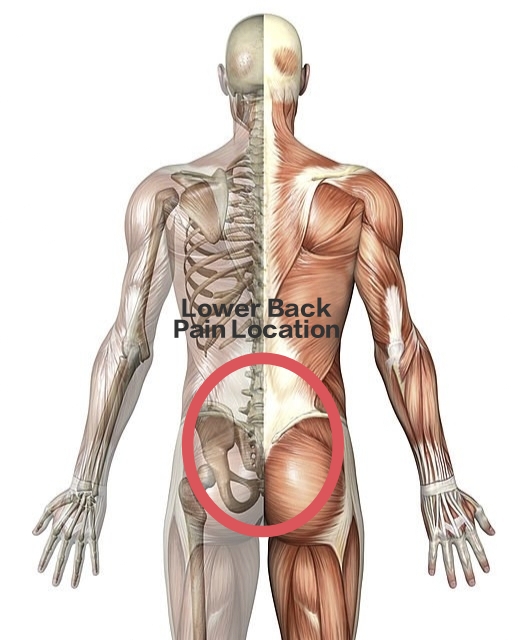 Figure 1: Location of Low Back Pain
Image source: istockphoto.com. Used for educational purposes.
What Causes Recurrent Chronic Lower Back Pain?
The shift from acute low back pain to become chronic low back pain is not just about time/duration. In most situations, recurrent CLBP does not arise from single or specific causes. Commonly recurrent CLBP are a combination or interaction between lifestyle, biological, psychological, and systemic health factors that reinforce one another.
Biological Factors and Systemic Health Factors:
- Overweight/Obesity > normal BMI
- Female > Male
- Ageing
- Degeneration of facet joints, discs, muscles, and ligaments → activates inflammatory pathways and nociceptors → ongoing pain.
- Deconditioning and muscle imbalance
- Faulty movement pattern
- Altered brain pain modulation and central sensitization: pain signals are “wrongly” or exaggeratedly triggered.
- Chronic diseases such as hypertension, diabetes, hyperlipidemia and arthritis
Lifestyle Factors:
- Smoking
- Workload: heavy lifting, frequent twisted/bent posture, prolonged sitting duration, and >8 hours/day work duration.
- Sedentary or low physical activity
- Poor sleep quality
Psychological and Social Factors:
- Depression
- Anxiety
- Emotional Distress
- Pain catastrophizing
- Fear Avoidance Behaviour: fear of pain lead to avoid movement.
- Low job satisfaction
- Low socioeconomic status
Who Is at Risk of Recurrent Chronic Lower Back Pain?
From what you read earlier; you’ve guessed it right:
- Female
- Older age
- Obesity or high-body-weight individuals
- Manual workers such construction workers
- Health Care Professionals that involve in frequent lifting, such as nurses
- Office workers: poor posture and long hours of sitting
- Homemakers: frequent lifting and bending while doing house chores
- Sedentary individual
- Individual with psychological and social issue
What Are the Symptoms of Recurrent Chronic Lower Back Pain?
Typical Pain Characteristic
- Location: Between lower ribs and gluteal (buttock) fold; might be located sometimes midline of the lower back and sometimes in the buttock area.
- Radiation: May radiate to the thigh/legs.
- Sensation: Varies; some describe as dull, aching, tight, stiff, sharp, or burning pain
- Episode and recurrence: “Attack” or episodes with a pain-free interval/break in between.
How Is Recurrent Chronic Lower Back Pain Diagnosed/Assessed?
At Rehab Concept, we assess all back pain cases including recurrent chronic lower back pain systemically to
- Rule out serious/emergency problem
- Understand physical/biological, lifestyle and psychosocial contributors/factors
- Guide the treatment.
What to Expect in Your Consultation:
- History taking – we asked about your symptoms and episodes and daily activities/impact on your functional, lifestyle and psychosocial statuses.
- Physical examination – We assess your posture, palpate your back and test your range of motion, strength, reflexes and nerve tension tests.
How Do We Treat Recurrent Chronic Lower Back Pain?
Since pain in recurrent chronic low back itself does not mean new injury or damage, does it need to be treated? The answer is YES. Despite no new tissue injury, the pain is real and often affecting many daily activities and social participation, eventually reducing the quality of life. Thus, it needs to be managed properly.
At Rehab Concept, we take an evidence-based approach to manage the recurrent CLBP. When the low back pain keeps coming back, our goal of treatment is to manage the pain, improve function and prevent/reduce the occurrence of flare-ups/episodes. The focus will mainly be on active strategies such as exercise and self-management education instead of passive treatment.
Our Intervention:
- Exercise therapy – Our physiotherapist will guide you through a personalised programme on type of exercise, intensity of exercise, progression, and modification of exercise. Components of exercise include the following:
- Core stability exercise such Pilates
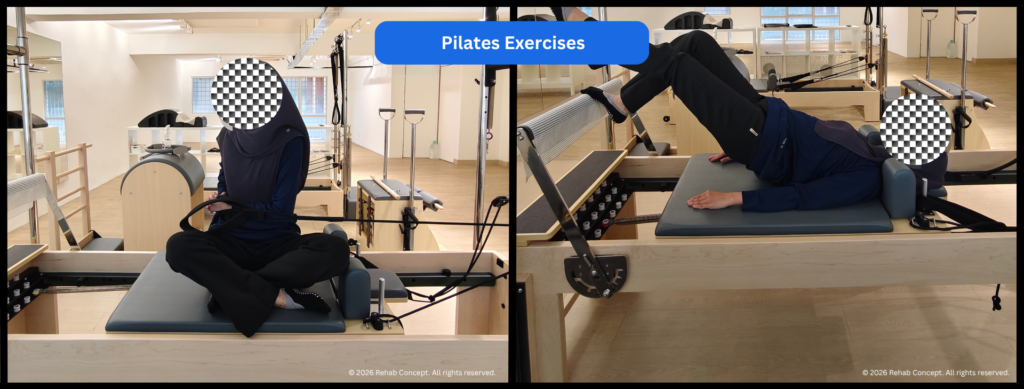 Figure 2: Example of Pilates exercises
- Balance exercise
- Strengthening exercise
- Stretching exercise
- Aerobic exercise
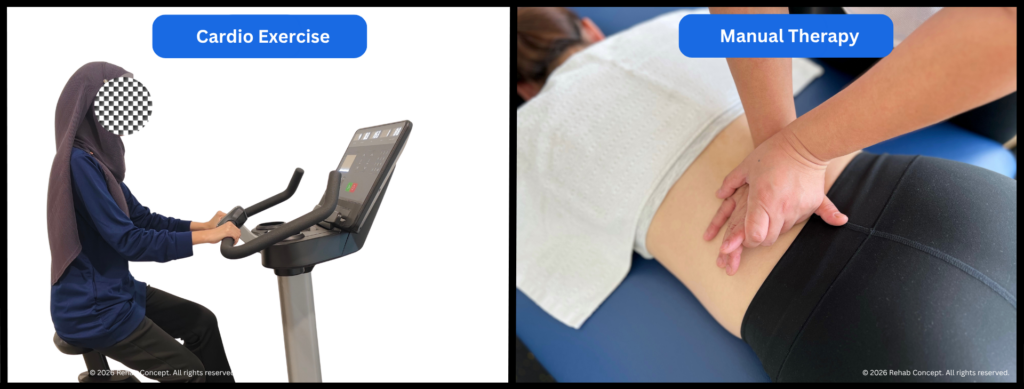 Figure 3: Example of Aerobic exercise
- Postural training – we assess and help you to improve your posture to reduce your pain.
- Manual therapy – when necessary, we use hands-on techniques such as joint mobilisation and soft tissue release to relieve tension and improve mobility. (Figure 3)
- Self-management and activity modification education – we shall advise you on how to self-manage and activity modification needed when a flare/episode comes.
What You Need to Know
To summarize,
- Recurrent chronic lower back pain is multifactorial in causes and affects various populations, such as females, obese individuals, those in high-demand physical activity work, individuals with sedentary lifestyles, and individuals with psychosocial issues.
- Physiotherapy is the effective treatment option, mainly focusing on active strategies such as exercise and education rather than passive treatment.
- Rehab Concept provides expert assessment, treatment, and personalised rehabilitation programmes to help patients improve their function and quality of life.
Frequently Asked Questions (FAQ)
Here are some other FAQs you might need to know:
- I’m in pain; should I rest or keep moving?
Generally, keep moving is better than resting in a chronic low back pain condition. Prolonged rest may worsen the pain and increase the impairment, such as tightness and stiffness, which affects the daily activity function.
- Is it fine to exercise if I still have pain?
In most cases it is yes; however, a guided and tailored exercise programme by physiotherapy is recommended to ensure safety with the proper exercise type, intensity, and progression.
- Will this pain forever haunt me?
Not necessarily. Although “chronic” means it has lasted a long period of time, with proper treatment, many people are able to manage their pain/symptoms so that it no longer interferes with daily function.
- Do I need an X-ray or MRI?
In most cases it is no, unless you have a “red flag” such as sudden leg weakness or bladder/bowel changes.
- What movement should I avoid doing to prevent worsening?
There are no specific trunk movements/directions to be avoided. Instead, it is better to learn techniques of proper lifting, avoid sudden overloading and gradually build strength and tolerance.
- What can I do to prevent future flares/episodes?
You are encouraged to stay physically active, maintain your strength, improve sleep quality and manage stress.
- Does every pain attack mean an episode of recurrence? Or is it possibly a new acute injury?
Having recurrent chronic low back pain does not mean you are resistant to a new acute injury. Your physiotherapist will be able to differentiate these with their assessment and manage you accordingly.
- When should I get worried/urgently see the doctor?
- New difficulty urinating or loss of bowel/bladder control.
- New numbness at inner thigh or groin (sign of Cauda Equina Syndrome)
- Progressive/worsening to stand or walk; foot drop/legs giving way
- Back pain accompanied with fever & chills (possibility of infection)
- Recent fall/accident
- Unexplained weight loss, night sweats, persistent fatigue
I want to find out more about my back pain, who should I contact?
- You can reach out to our centres by clicking on the floating WhatsApp button on our page — we’ll be happy to guide you
Follow our instagram and check out some helpful tips here: https://www.instagram.com/reel/DFmX4CIPYOA/?igsh=cGdmeTQ3aHVrN3Vz