Is My Neck Pain Coming from a Muscle or a Nerve?

‘I got this sharp pain in my neck. My friend told me it must be my nerve. I got freaked out and I went to see the doctor. But he said it’s just my muscle. And you said it’s the muscle as well, not my nerve. Pheww…’
‘but, out of curiosity, how do you know if it’s coming from a muscle… or a nerve?’
Yes, you are asking a valid question that deserves clarity. If this is you, you’re at the right place to learn more about your neck pain. In this series, we are going to answer 3 of the most common questions:
- Is My Neck Pain Coming from a Muscle or a Nerve?
- Why Is My Neck Pain Spreading to My Arm?
- Why Is My Arm Getting Weak from Neck Pain?
This article focuses on question 1. After reading this article, you will be able to understand how we diagnose whether your neck pain originates from your muscle or your nerve.
What’s there in the neck that gives me neck pain?
First thing first, let’s look at the neck anatomical structures before we dwell further on neck pain.
The neck, known as cervical spine – is made up of 7 segments of vertebrae body, namely C1 to C7(Figure 1). These seven vertebrae segments extend downward from the skull to the upper back, where the last cervical vertebrae (C7) joins the thoracic spine first vertebrae(T1). Biomechanically, both the cervical spine, thoracic spine, and the muscles around them, work closely to move your neck, upper back, and shoulder. Neck pain refers to any pain arises within the cervical area extending into the shoulder or upper back. In some cases, it may refer upward to the head, or downward towards the arm.
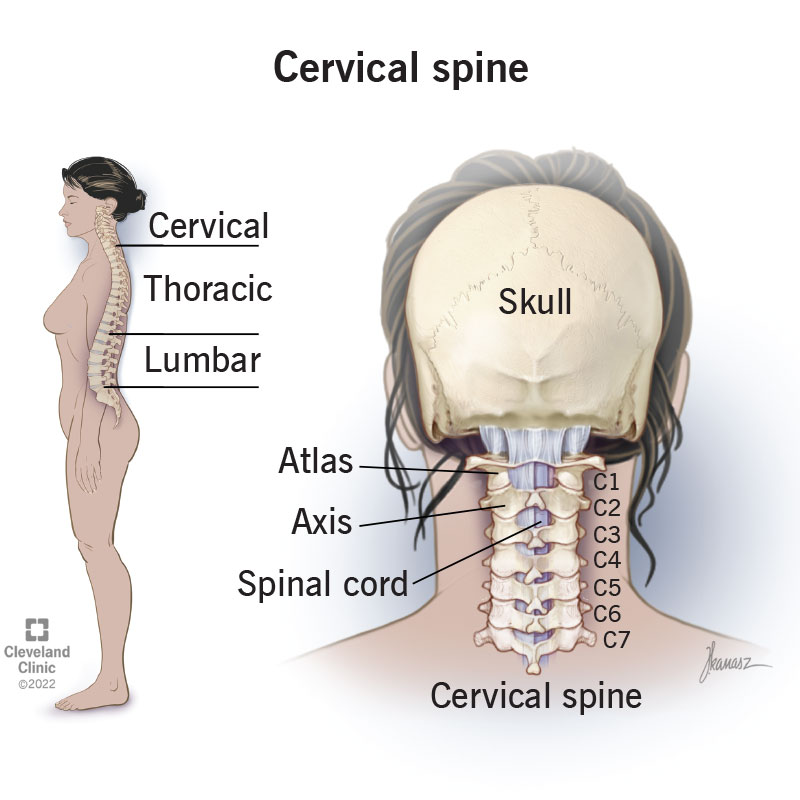
Figure 1: Cervical spine anatomy (C1–C7).
Image source: Cleveland Clinic (2022). Used for educational purposes.
In the neck there are twenty over muscles that help to move the neck in various directions. These muscles are categorized into 3 regions. Here’re some of the major ones:
- the anterior(front) neck muscles (Figure 2 & 3):
- Superficial & major muscles – Platysma, Sternocleidomastoid (SCM), Upper Trapezius, Scalenes
- Deep anterior neck muscles: Longus capitis, Digastric, Mylohyoid, Thyrohyoid, Sternohyoid, Sternothyroid, Omohyoid.
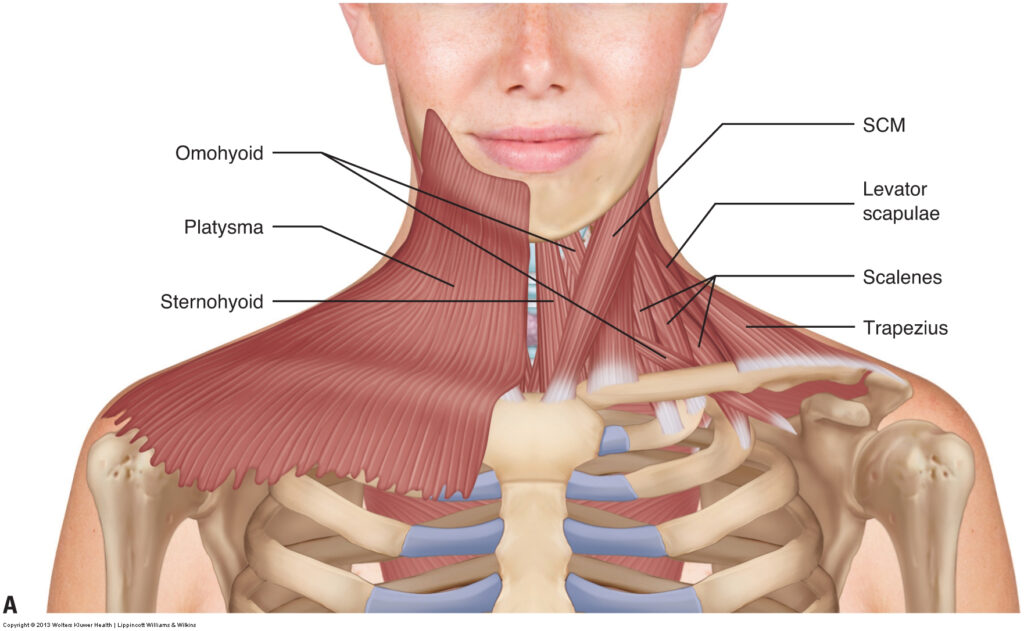
Figure 2: Anterior neck muscles.
Image source: Wolters Kluwer Health, Lippincott Williams & Wilkins (2013). Used for educational purposes.
- lateral(side) neck muscles (Figure 3):
- Levator scapulae, Scalenes, Sternocleidomastoid (SCM) & Trapezius
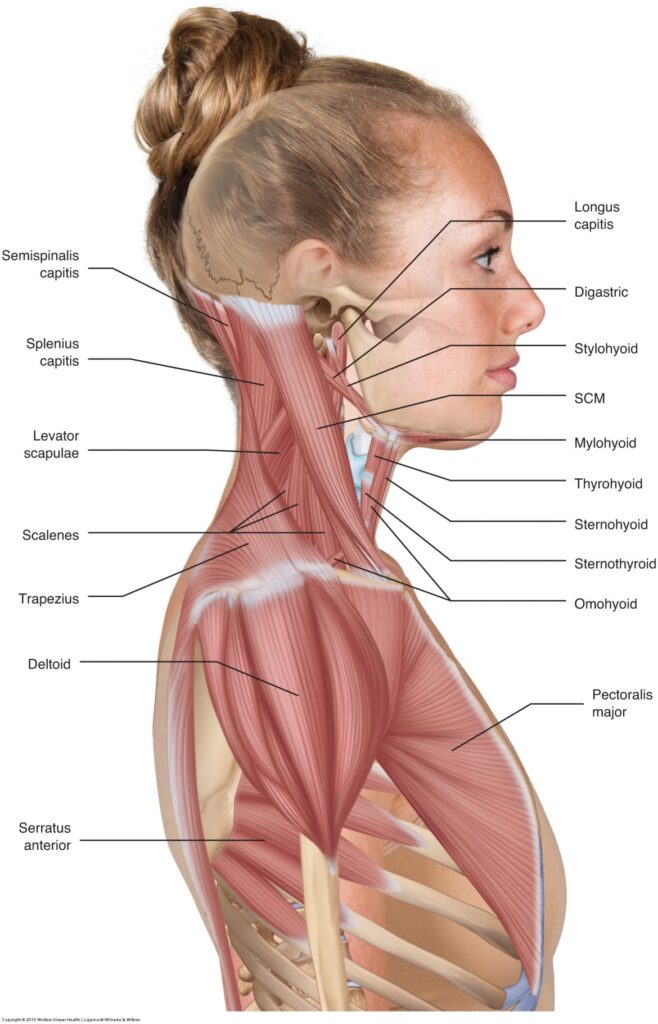
Figure 3: Lateral neck muscles.
Image source: Wolters Kluwer Health, Lippincott Williams & Wilkins (2013). Used for educational purposes.
- posterior (back) neck muscles (Figure 4):
- Semispinalis capitis, Splenius capitis, Trapezius, Levator scapulae, Rhomboids, Serratus posterior superior
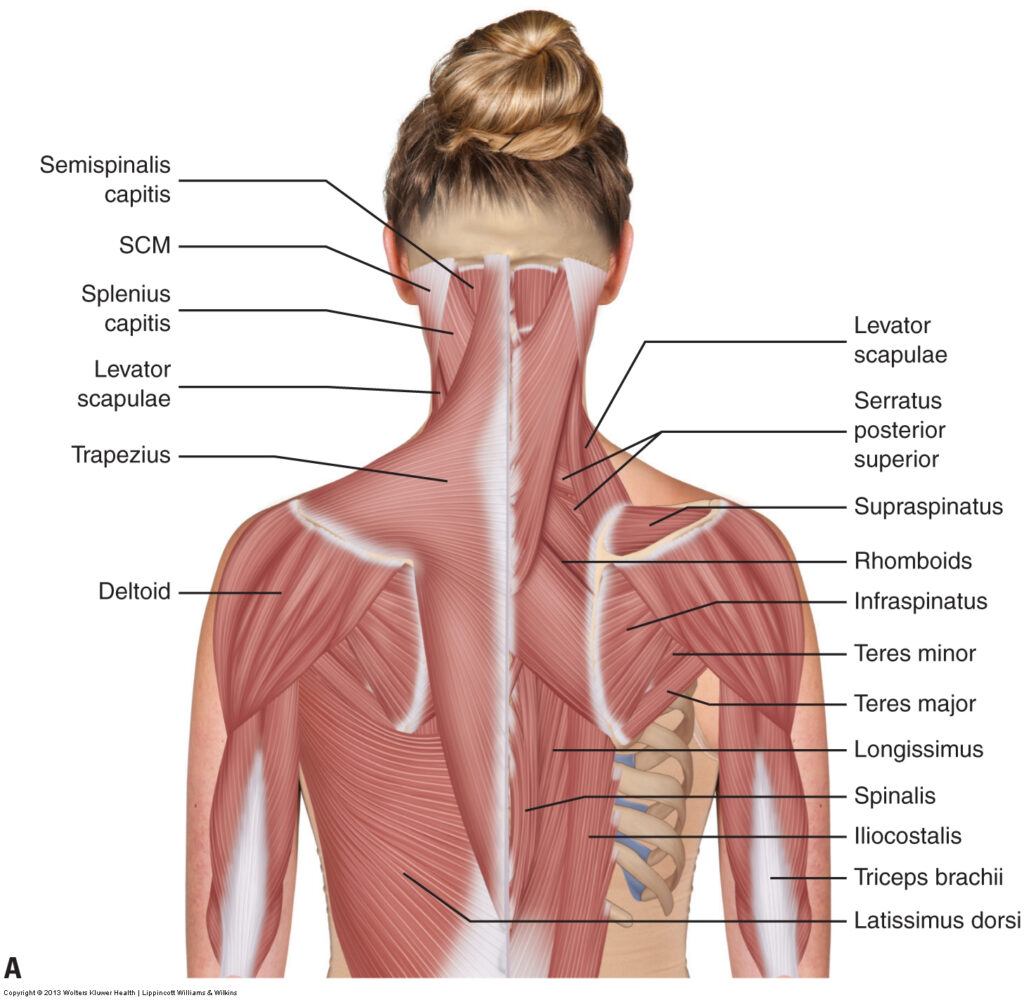
Figure 4: Posterior neck muscles.
Image source: Wolters Kluwer Health, Lippincott Williams & Wilkins (2013). Used for educational purposes.
Most neck tightness people feel usually comes from:
- Upper Trapezius
- Levator Scapulae
- Scalenes
- Sternocleidomastoid (SCM)
See how we treat these muscles in the ‘What We Can Do’ segment below.
When It’s Likely a Muscle Problem
Neck pain of muscle origins is often characterised by localised pain, where one often describes it as dull, tight, ache, or sore in the neck. The pain often worsen with movement or after prolonged activities.
Common causes of neck pain of muscular origins are:
i. Posture
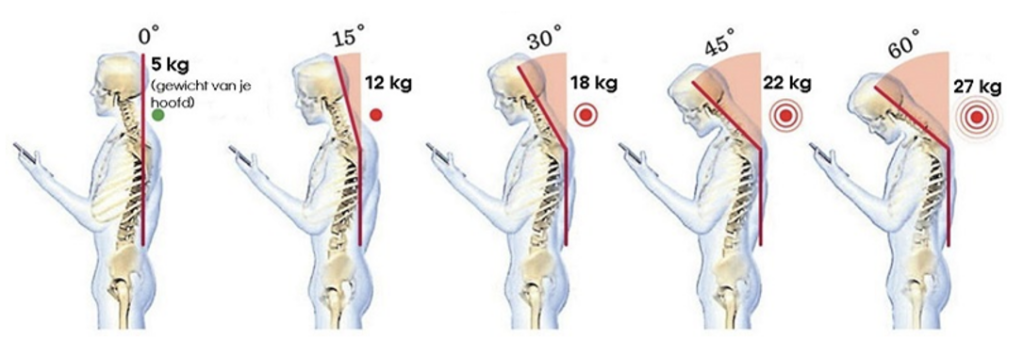
- Poked-chin, forward bend posture, slouch posture often lead to neck pain due to muscle strain.
- The image below illustrates how neck posture increasingly strains the neck. As the inclination increases, the strain (measured in kilogram) on the neck increases by 5.5 times from 5kg to 27kg.
ii. Overuse
- Professions most affected are desk workers who spend long hours in a static posture, with poor ergonomic setup.
- Overuse affects not only the neck muscles but also other muscles around the shoulder.
- This group often exhibits muscle imbalance around the neck and shoulder – leading to more movement compensation and poor postural awareness.
iii. Stress
- In general, stress heightens tissue sensitivity, setting the body into a more ‘reactive’ state, increasing muscle and joint guarding. Therefore, during stressful periods, one may experience acute or recurrent neck pain
Whereas when it might be nerve pain, one often complains of sharp, burning pain, or an electrical sensation, with pain radiating or travelling down from the neck to the arm. One may also experience numbness and tingling in the arm. In some severe cases, where nerve compression occurs, one may experience weakness in the arm and hand. Learn more about neck pain of nerve origin in the next two articles.
Here’s a comparison of common symptoms (but not exclusively) for both muscle and nerve origin neck pain.
| Muscle | Nerve |
| Local | Radiating |
| Dull/tight/ache/sore | Sharp/burning |
| No numbness | Tingling/numbness |
| No weakness | Muscle weakness in the arm |
| Worsen with activities | Persistent, may worsen with neck position |
| Improves with rest | Persistent, does not completely eased off |
How We Diagnose It
Here’s how we diagnosed when one with neck pain
Step 1: A thorough assessment of your case history
- We ask a series of relevant questions to gather useful information about your condition, such as: when and how your neck pain started, what makes it worse, what makes it better, whether you had neck pain previously, how it was managed, and how it has affected your lifestyle or activity now.
- We also need to rule out potential serious issues, what we call red flags. We ask questions such as: has it affected your appetite, does it wake you up at night, have you experienced weakness or loss of sensation in your arms.
Step 2: Palpation & Movement testing
- Once we have enough information gathered from Step 1, observing the neck and shoulder muscles gives us some ideas of which areas require attention in relation to the pain site.
- Palpation around the areas often leads to findings of tight or spasm muscles that reproduce pain. A series of movement tests are then performed to assess muscle length and cervical joint movement in all directions.
- A neck pain case of muscular origin normally reproduces the same pain when the affected muscle is stretched. Limited range of movement is also expected due to muscle spasm or inflammation.
Step 3: Special tests
- Due to the close proximity of the shoulder to the neck, for every new pain onset, we also conduct special tests to rule out whether the pain originates from the shoulder. A few tests include Speed’s test, Hawkins-Kennedy test, and Empty Can test. If these tests return negative, neck pain of muscular origin is then a confirmed diagnosis.
Do You Need Imaging?
In some cases, where we suspect there are other issues to rule out, yes, we may refer you to a spine specialist for further assessment. When one comes to us after a recent injury and the pain does not present like a typical musculoskeletal condition, it is best to have further investigation done.
What We Can Do
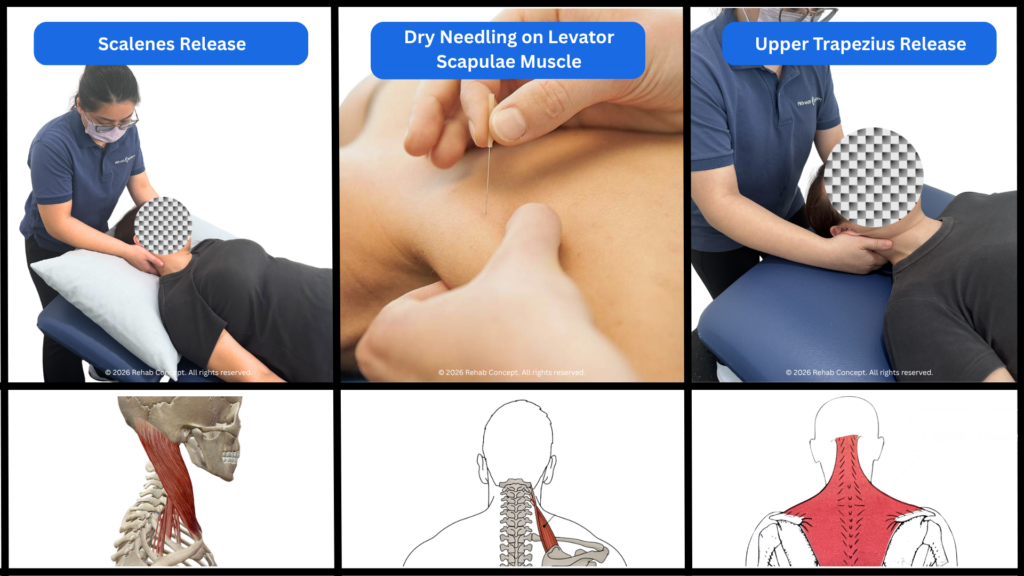 Treatment for neck pain of muscular origins aims to reduce pain, restore movement and prevent recurrence.
- To reduce pain
- Manual therapy such as muscle stretching, ultrasound therapy, dry needling, or applying a hot pack helps to reduce pain.
- For some cases where a high pain score becomes a limiting factor, it is essential to incorporate medication management.
- To restore movement
- Stretching exercises will be taught to help you with self-management.
- To prevent recurrent
- Neck pain contributing factors such as posture or ergonomic issues will be addressed. Proper work desk setup, limiting prolonged sitting by setting reminders, lifestyle changes, and pacing work are useful strategies to help prevent recurrence.
What You Need to Know
To summarize,
- Neck pain symptoms are not universal. Some neck pain can be of both muscle and nerve origin. Some neck pain may sound like a ‘muscle issue’ but may be a nerve issue, and vice versa.
- Acute neck pain is a very common condition, with an estimated 10% to 50% of adults experiencing a neck pain episode every year.
- Acute neck pain of muscle origin typically resolves within a few days to two weeks.
- Not all neck pain is the same — getting assessed early is the way to go.
Frequently Asked Questions (FAQ)
Here’re some other FAQ you need to know:
- How can I tell if my neck pain is muscular or nerve-related?
Muscle pain is usually localised and feels tight or sore. Nerve-related pain tends to travel, often into the shoulder or arm, and may come with numbness or tingling. - Can muscle pain turn into nerve pain?
In some cases, prolonged strain or poor posture may contribute to joint or disc changes, which can eventually irritate a nerve. - Why does my neck feel tight but also slightly “electric” at times?
That “electric” sensation may suggest nerve involvement. It is different from the dull ache typically seen in muscle tightness. - Does posture affect both muscle and nerve pain?
Yes. Poor posture can overload muscles and also increase pressure on the joints and discs, which may irritate nearby nerves. - Can I treat muscle pain and nerve pain the same way?
Not exactly. While some exercises may overlap, nerve-related pain often requires more specific approaches to reduce compression and restore nerve function. - When should I get my neck pain assessed?
If your symptoms persist beyond a few days, or if you notice pain spreading, numbness, or weakness, it is best to get it checked. - Will massage alone solve my neck pain?
Massage can help with muscle tension, but if the source is nerve-related, additional treatment is usually needed. - Can physiotherapy help identify the cause of my pain?
Yes. A proper assessment helps differentiate whether your pain is coming from muscles, joints, or nerves, so treatment can be targeted. - I want to find out more about my neck pain, who should I contact?
You can reach out to our centres by clicking on the floating WhatsApp button on the right — we’ll be happy to guide you.
Don’t forget to check out the two other articles:
Follow our Instagram and check out some helpful tips here: https://www.instagram.com/reel/DFhtqPkPhdw/?igsh=dnZ4OWZlc2Q2OGlt